When and How to Re-Stain a Log Home, Deck or Fence
Wood stain works differently from paint, and so does the schedule for redoing it, so here is what we look for and what the work involves.
October 6, 2026 · 4 min read
Wood that is left bare outdoors does not last long in a place with real sun, real snow and real temperature swings. A good stain slows that down and keeps the wood looking like wood. Unlike paint, though, stain is meant to be redone on a schedule, and the people who get the best results are the ones who redo it before the wood gives them an obvious reason to.
Stain and paint are different jobs
Staining penetrates the wood to enhance its natural grain and color, while paint covers the surface completely. That is the whole appeal of stain. You still see the wood, the grain and the character of the logs, boards or rails. It is also why stain fades and wears down instead of peeling in sheets the way tired paint does. A stain that is past its time usually looks thin, blotchy and gray rather than flaking.
How long stain lasts
Depending on the surface and how much weather it gets, quality stain can last 3-5 years on horizontal surfaces like decks and 5-7 years on vertical surfaces like fences and siding. Horizontal surfaces wear faster because they take the sun full on, hold standing water and get walked on. Vertical surfaces shed water better and see less direct punishment.
Those ranges are a starting point. A deck under open sky will not last as long as one with shade over half of it, and the south side of a log home will age sooner than the north side. Look at the wood rather than the calendar.
Signs it is time to re-stain
- Water soaks into the wood and darkens it instead of beading up on the surface.
- The color has faded unevenly, with the sunniest spots going gray first.
- Bare patches show where foot traffic or weather has worn the finish away.
- Dark spots or mildew keep returning on shaded boards.
- The surface feels dry and rough rather than smooth and slightly sealed.
- On log homes, the sun-facing walls look dull and washed out compared with the protected side.
If you catch it at the fading stage, the job is simpler. If you wait until the wood is gray and the grain is raised, there is more prep to do first.
What the work involves
Old stain can be refreshed. We strip the old stain, prep the surface and apply fresh stain, and the prep decides how the finish looks and how long it lasts. Fresh stain applied over a dirty, sealed or half-worn surface does not soak in evenly, and you can see the difference in the first season.
- Strip. Remove the old, failing finish so new stain can reach clean wood and take evenly.
- Clean. Take off dirt, mildew and anything else that would stop the stain from soaking in.
- Prep. Sand where the surface is rough or raised, and repair or flag any boards or logs that have gone past saving.
- Stain. Apply the new finish evenly, working with the grain, and keep a wet edge so you do not get lap marks.
- Protect. Let it cure properly before furniture goes back and foot traffic starts.
Log homes are a different scale of job
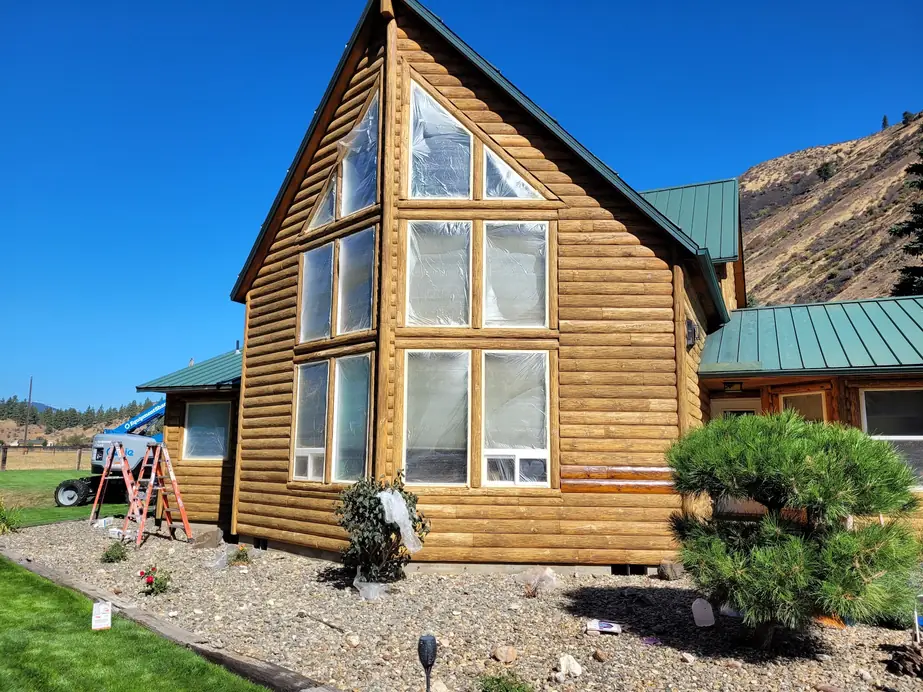
Log homes are some of the work we're proudest of, and they are a different animal from a fence or a deck. The surface area is large, the walls are tall, and every log has its own texture, so the crew needs ladders, lifts and a plan for working across the whole elevation so the color stays even from one wall to the next. Windows and roofing get masked so stain does not end up where it should not.
Our own photos show it better than a paragraph can. Two of the full log-home exteriors we have re-stained are on this site, one with the windows still masked in plastic and the crew's equipment on site. A log home carries a lot of value, and the stain is what keeps moisture and sun from working on the logs, so we treat it with the care it deserves.
Decks and fences
The same logic applies on a smaller scale. A deck has the toughest life of any stained surface at your house, so pay extra attention to the boards that take the most sun and the spots where water sits. For fences and gates, the vertical surfaces give you more years between jobs, but fence tops and the bottoms of boards near the ground still wear faster than the middle.
We also stain pergolas, arbors, porches, wood siding, interior wood surfaces and outdoor furniture. If you have a mix of surfaces, it often makes sense to do them together so the color matches and you only live with the disruption once.
Getting an estimate
If you are not sure whether your wood needs a refresh or a full strip, the easiest way to find out is to have someone look at it in person. We offer a free on-site estimate, no obligation. You can reach us at (509) 910-1408, or use the contact page and tell us what you have. We serve Yakima and the communities around it, within about 60 miles.
Castillo Custom Painting, (509) 910-1408
Call (509) 910-1408More articles
How Often Should You Repaint Your House Exterior in Yakima?
Our honest answer on repainting timelines in the Yakima Valley, plus the signs that tell you the paint has stopped protecting the house.
Choosing Exterior Paint Colors You Will Not Regret
Color is the part of a paint job people worry about most, and the part that is easiest to get right with a few simple habits.